
What Are the Best VoIP Phones to Resell?
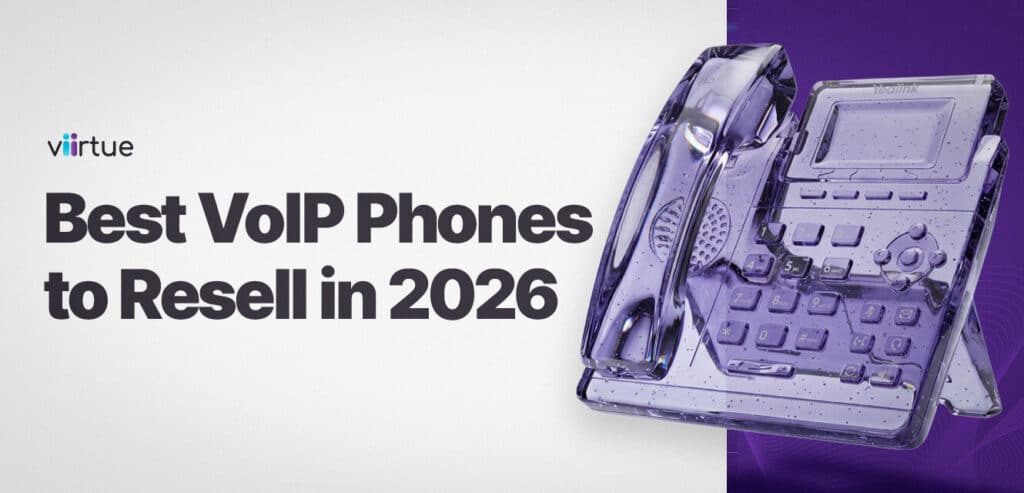
If you are an MSP, IT provider, or telecom reseller evaluating the best VoIP phones to resell, the answer is not a single model. It is a standardized lineup that covers everyday desks, reception consoles, cordless mobility, conference rooms, paging, and door access while keeping provisioning fast and support tickets low. This guide ranks six proven phone families from a reseller operations perspective, plus the paging and door phone options most buyer guides ignore entirely. You will also learn how the right phone lineup connects to quoting, billing, and provisioning workflows that protect margins at scale.
How to Become a VoIP Reseller: 7 Steps for MSPs and IT Providers
If you want to learn how to become a VoIP reseller, the path is more operational than most guides let on. This post breaks down seven practical steps for MSPs and IT providers, from choosing a niche and picking the right white-label partner to building a quote-to-cash workflow that actually protects margins at scale. You will learn why billing infrastructure, telecom tax handling, and compliance readiness matter more than seat price when evaluating a VoIP reseller program. Whether you are launching a new voice practice or expanding an existing managed services business, this guide covers what it takes to build a VoIP reseller business that grows without creating operational drag.
How to Tune AI Voice Agents for MSPs
Most AI voice agent failures are not model failures. They are tuning failures. This guide breaks down how MSPs and telecom resellers can tune AI voice agents for better call handling, scheduling, support triage, and lead capture. Every recommendation comes from real deployment patterns, not theory. You will learn how to write operator-level instructions, connect integrations deliberately, set hard scheduling rules, and use sentiment data to find tuning opportunities faster. The guide also covers when to split overloaded agents into specialists and how to package AI voice tuning as a recurring managed service that clients actually want to pay for monthly.
Selling POTS Replacement in 2026 For Service Providers
Selling POTS replacement is one of the clearest recurring revenue opportunities for MSPs in 2026. Copper retirement is accelerating, carrier discontinuance notices are increasing, and businesses still depend on analog endpoints for elevators, alarms, fax machines, and emergency systems. This guide covers how MSPs can audit customer environments, choose the right replacement path, package the service as a managed monthly offer, and run the full lifecycle through Viirtue’s white-label platform with ViiBE quote-to-cash automation. Whether you need simple SIP ATA deployments, Class 4 trunking at scale, or PRI gateway handoffs for legacy PBXs, Viirtue gives resellers the deployment flexibility and operational infrastructure to turn POTS replacement into scalable MRR.
Telecom Usage Rating for AI Voice Resellers: How to Bill Per-Minute AI Usage Without Losing Margin
Telecom usage rating is the engine that turns raw AI voice minutes into accurate, defensible invoices. If you resell AI voice agents with phone numbers and PSTN connectivity, generic metering tools will not cut it. Your billing system needs to understand direction, number type, destination, rounding rules, bundles, overages, and telecom taxes. This post breaks down what telecom usage rating actually means for AI voice resellers, why it matters more than most teams realize, and how Viirtue’s ViiBE platform handles it as part of a complete quote-to-cash workflow.
How to Set Up an AI Receptionist: Top 3 Ways to Deploy AI Voice Agents for Small Businesses
Setting up an AI receptionist is not just about picking software. It is about choosing the right deployment model for your business. This guide breaks down the top three ways small businesses deploy AI voice agents, from white-glove setup through a local Viirtue reseller to co-managed and fully DIY approaches, with real data on where SMB AI adoption stands today. With 58% of small businesses already using generative AI but only 9% applying it to customer service, the execution gap is exactly where deployment support matters most. If you want an AI receptionist that actually works in production, start here.
AI Voice Agent Failover: Ensuring Continuity with Automated Routing
AI voice agent failover is the mechanism that keeps inbound calls moving when an AI service is interrupted—and for production deployments, it is not optional. Viirtue approaches AI voice agent failover as a first-class design requirement, applying the same Offline Mode and Emergency Number Forwarding logic used in carrier-grade PBX environments to automatically reroute calls when an AI endpoint is unavailable. Because Viirtue AI Voice Agents live natively inside Viirtue Cloud PBX—not as a bolt-on integration—failover can target real PBX objects like call queues, ring groups, IVR menus, and voicemail, not just a generic backup phone number. Backed by geo-redundant call processing across four data centers and a 99.99% uptime commitment, Viirtue gives MSPs a reliable foundation to sell AI voice as a managed service with genuine continuity guarantees.
How to Factory Reset a Grandstream Phone or ATA (GRP, GXP, HT Series)
Factory resetting a Grandstream phone is one of the most common tasks MSPs and VoIP technicians handle during device redeployments, tenant changes, and troubleshooting cycles. This guide covers step-by-step factory reset instructions for every major Grandstream series, including GRP260x, GRP261x, GXP21xx, GXP16xx, and HT801/HT802 ATAs, using phone menus, boot key combos, pinhole resets, and IVR methods. You will also find default login credentials after reset, tips for dealing with auto-provisioning loops that pull old configs back immediately, and practical MSP workflows for clean reprovisioning. Whether you need to factory reset a Grandstream phone before a new deployment or recover a locked-out ATA in the field, this is the only reference you need.
The Best Usage-Based Billing System for AI Voice Resellers: Why Viirtue’s ViiBE Is the One Platform That Actually Does It All
Most AI voice resellers lose margin not because their product fails, but because their billing stack can’t keep up with telecom-grade complexity. A usage-based billing system for AI voice resellers needs to do far more than meter minutes. It has to rate usage accurately across carrier types and destinations, automate layered telecom taxes and fees, and collect payments without manual intervention. This post breaks down the nine requirements that separate real billing infrastructure from bolted-together SaaS tools, and explains why ViiBE is built to handle the full quote-to-cash workflow that AI voice resale actually demands.
ViiBE Release Highlights 2025–2026: 15 Key Features for VoIP Billing and AI Voice Resellers
Managing VoIP billing at scale requires more than basic invoicing and a payment processor. ViiBE, Viirtue’s quote-to-cash engine, is purpose-built for MSPs, UCaaS resellers, and AI voice operators who need automated invoicing, flexible payment processing, collections enforcement, and operator-grade reporting all working together under one roof. This post breaks down the top 15 features shipped over the last year, covering everything from multi-location group invoices and multi-gateway payment support to automated bounced payment fees, late fee configuration, and a completely redesigned reporting suite. If your VoIP billing workflow still relies on spreadsheets, manual follow-ups, or a patchwork of disconnected tools, these updates were built to eliminate that friction and help you scale.